

Bachelor of Education (B.Ed)
Certificate Courses
Certificate Courses
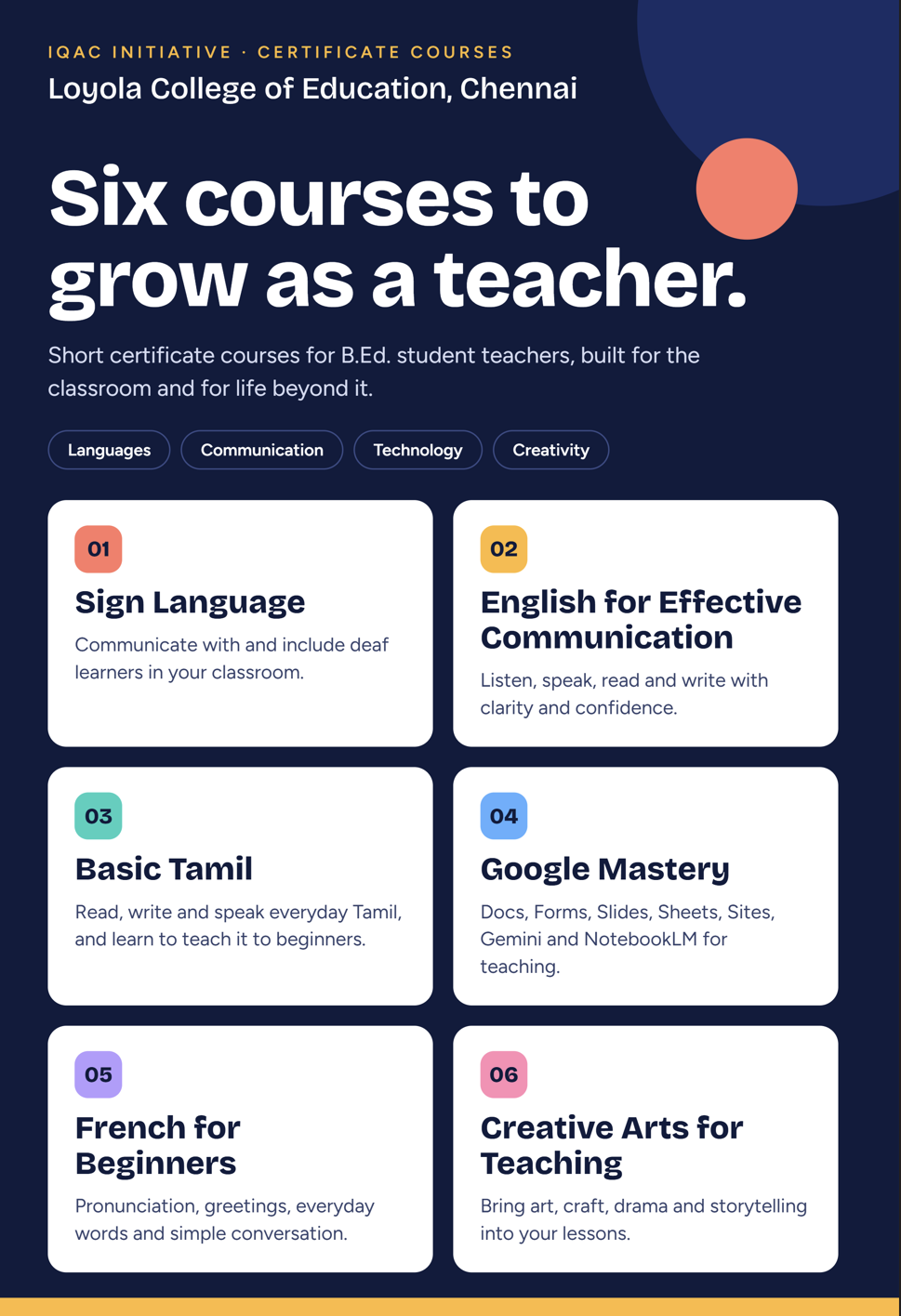
1. Sign Language
In collaboration with St. Louis Institute for Deaf and Blind, Adyar
This course gives student teachers a working knowledge of sign language so they can include and communicate with deaf learners. It is organised by the Loyola College of Education Research Forum (LCERF) and IQAC, and taught online by resource persons from St. Louis. It is open to II-year B.Ed. student teachers.
- Basic Sign Skills: single-handed and two-handed alphabets, greetings, emotions and feelings, verbs, numerals, colours, shapes, food, and professions.
- Basic Communication, Levels I and II: time, direction, money, weather, animals and festivals, plus school subjects, telecommunication and medical terms, and simple phrases and sentences.
- Outcome: participants can express greetings, emotions, time and direction in sign language, and converse with deaf people using everyday and school-related vocabulary.
2. English for Effective Communication
This course builds communication skills for the classroom and beyond. It is offline and open to I-year B.Ed. students. Participants learn to:
- understand spoken language and the basic etiquette of communication
- recognise basic sentence forms in speech and writing
- express ideas clearly and effectively
- develop listening, speaking, reading and writing skills
- use body language effectively
3. Basic Tamil
This course equips student teachers with the essentials of Tamil, including the skills to teach it to beginners. It is offline and open to I-year B.Ed. students.
- Content: the Tamil script (vowels, consonants, Grantha letters, numerals), basic words and grammar, relationship words, directions, days and months, shapes and colours, tastes, fruits, vegetables, birds, animals, body parts, greetings, and everyday conversations.
- Outcome: participants can read and write Tamil words, construct simple sentences, apply basic grammar, and use vocabulary for classroom conversations.
- Feedback: participants rated the programme 90% effective overall (“Excellent”).
4. Google Mastery
Offered by the ICT Cell
This course helps participants use Google’s suite of tools and AI assistants confidently for teaching, collaboration and personal productivity. It combines theory with hands-on practice. Topics are:
- Google Docs
- Google Forms
- Google Slides
- Google Sheets
- Google Sites
- Gemini
- NotebookLM
5. French for Beginners
This course introduces student teachers to the French language, covering the alphabet and pronunciation, common greetings, numbers, everyday vocabulary and simple conversational phrases. It is meant for learners with no prior knowledge of French and builds basic listening, speaking, reading and writing skills.
6. Creative Arts for Teaching
This course helps student teachers use creative arts to make lessons more engaging. It introduces ways to bring visual art, craft, drama and storytelling into classroom teaching, and to design simple teaching aids that support learning across subjects.
For enquiries: please contact the IQAC Coordinator, Loyola College of Education, Nungambakkam, Chennai – 600 034.
Course Format
- Duration: 20 hours per course, spread over the weeks of the semester.
- Pacing: self-paced, at about 6–7 hours per unit.
- Orientation: the faculty-in-charge gives an orientation session explaining how to navigate the course.
- Assessment: each unit ends with an assignment, submitted as a soft-bound written document in the format prescribed by the IQAC. Each course carries 50 marks.
- Certification: student-teachers who score at least 30 out of 50 receive a Certificate of Completion with grade, which is added to their portfolio. Those who score below this may resubmit once.
Guiding the Learner: Principles and Practices
This course helps student-teachers understand and support children’s learning, behaviour and emotional well-being in the school setting. Participants learn to observe children, identify factors that affect learning, respond to emotional and conduct problems, and work with parents and colleagues.
- Unit 1 – Introduction to Guidance: meaning, need and aims of guidance, guidance services in schools, techniques of observing children, and the role of teachers and parents.
- Unit 2 – Dealing with Learning Problems: factors affecting learning, assessment and remediation of learning disabilities, attentiveness, motivation and interest.
- Unit 3 – Guiding Socio-Emotional Development: fear, anxiety, aggression and truancy, the needs of SC/ST children and girls, and therapeutic approaches such as play, art, music and dance therapy and roleplay.
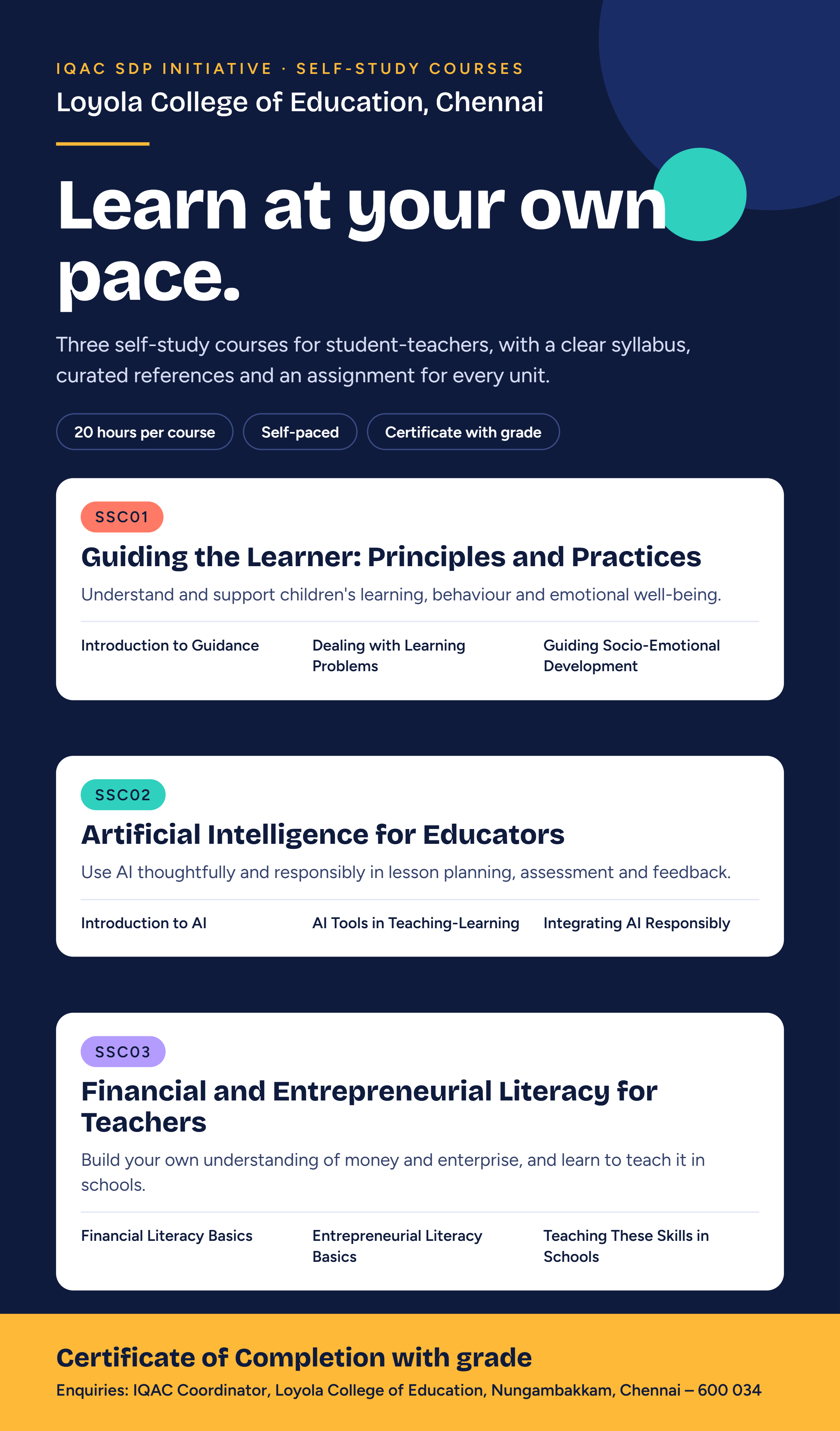
Artificial Intelligence for Educators
This course prepares student-teachers to use AI thoughtfully and responsibly in teaching. Participants learn the basics of AI, explore practical AI tools for the classroom, and consider the ethical questions that come with them.
- Unit 1 – Introduction to AI: basic concepts and history of AI, the differences between AI, machine learning and deep learning, and areas of application.
- Unit 2 – AI Tools and Applications in Teaching-Learning: tools for lesson planning and content creation, personalised and adaptive learning, assessment and feedback, inclusive education, and support for multilingual classrooms.
- Unit 3 – Integrating AI Responsibly in School Practice: building digital and AI literacy, encouraging critical thinking, ethical use of AI (academic honesty, data protection, bias), and preparing students for an AI-driven future.
Financial and Entrepreneurial Literacy for Teachers
This course builds student-teachers’ own understanding of money and enterprise, and prepares them to teach these ideas in schools through activities and projects.
- Unit 1 – Financial Literacy Basics: budgeting and saving, banking and digital payments, interest and compounding, savings and investment options, credit and loans, insurance and tax basics, and digital financial safety.
- Unit 2 – Entrepreneurial Literacy Basics: the entrepreneurial mindset, idea generation, business models, marketing and pricing, sources of funding, and social and digital entrepreneurship.
- Unit 3 – Teaching These Skills in Schools: age-appropriate teaching strategies, activity-based and project-based learning, integrating these ideas into existing subjects, and simple tools to assess understanding.
| 1.1.1 Pedagogy |
| 1.1.2 Education |
| 1.1.3 Basic Discipline Skill |
| 2.1.1 Digital Pedagogy |
| 2.1.2 Learner’s Psychology |
| 2.1.3 Women’s Empowerment |
| 2.1.4 Entrepreneurship Development |
